
 By NewsMatrix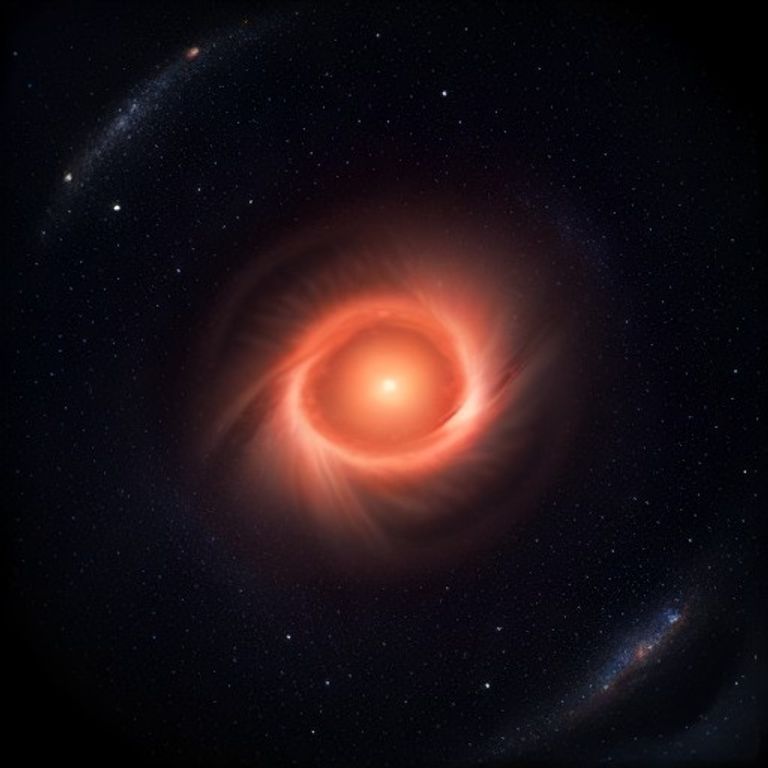
Hyderabad Astronomer Rohan Naidu Unlocks Secrets of Early Universe Black Holes
Hyderabad, India – In a monumental leap for astrophysics, Rohan Naidu, a distinguished astronomer hailing from Hyderabad, is spearheading groundbreaking research that promises to redefine our understanding of the cosmos’s nascent stages. His recent study focuses on a peculiar cosmic dawn object, unveiling a supermassive black hole dramatically enveloped by a dense shroud of gas. This critical discovery not only illuminates the remarkably rapid growth of these colossal entities in the universe’s infancy but also offers profound insights into the enigmatic ‘little red dots’ recently observed by the revolutionary James Webb Space Telescope. Naidu’s work is providing crucial pieces to the cosmic puzzle, bridging observational data with theoretical models to explain the seemingly impossible speed at which these **Early Universe Black Holes** achieved their immense sizes.
The Cosmic Dawn: A Universe in its Infancy
The cosmic dawn represents a pivotal epoch in the universe’s history, occurring roughly 200 million to one billion years after the Big Bang. During this period, the first stars and galaxies ignited, ending the cosmic “dark ages” and beginning the process of reionization, where the universe transformed from a neutral, opaque state to the transparent, ionized state we observe today. It was a time of intense activity and rapid evolution, laying the groundwork for the vast cosmic structures we see around us. However, understanding the exact mechanisms and timescales of these early processes has remained one of astronomy’s most formidable challenges.
One of the most perplexing mysteries of the cosmic dawn is the existence of supermassive black holes (SMBHs) that appear to have grown to billions of solar masses in what seems like an impossibly short time. Current models of black hole growth, which typically involve accretion of gas and mergers with other black holes, struggle to explain how such massive objects could form so early in the universe’s history. This apparent discrepancy has led scientists to hypothesize about various exotic scenarios, including direct collapse black holes or rapid “hyper-accretion” events, but concrete observational evidence has been scarce.
Rohan Naidu’s Groundbreaking Study: A Glimpse into a Shrouded Giant
Dr. Rohan Naidu’s recent research, leveraging sophisticated astronomical techniques and data analysis, has provided unprecedented clarity on this matter. His team meticulously studied a specific cosmic dawn object, which spectroscopic analysis revealed to harbor a supermassive black hole. What makes this discovery particularly profound is the black hole’s environment: it is encased within an exceptionally dense envelope of gas. This dense gas reservoir is crucial, as it provides the abundant fuel necessary for the black hole to accrete matter at an extraordinarily high rate, far exceeding what was previously thought possible for such early epochs.
The observation suggests a scenario where these early black holes were not just growing but thriving in extremely gas-rich environments. The sheer density of the gas around the black hole would have created conditions for sustained and rapid accretion, allowing it to balloon to supermassive proportions within hundreds of millions of years of the Big Bang. This finding provides direct empirical evidence supporting theories of hyper-accretion, offering a viable pathway for the rapid formation of early SMBHs and challenging existing constraints on their growth rates.
Naidu’s methodology involved intricate analysis of light signatures, looking for specific spectral lines that indicate the presence of rapidly moving, heated gas, characteristic of matter being drawn into a black hole. The robustness of the data points towards a scenario where the black hole is actively feeding, not merely passively existing. This actively accreting nature is key to understanding its quick ascent to supermassiveness.
Connecting the Dots: The Webb Telescope’s ‘Little Red Dots’
Perhaps one of the most exciting implications of Naidu’s research lies in its potential connection to the tantalizing ‘little red dots’ recently discovered by the James Webb Space Telescope (JWST). These extremely red objects, observed in deep-field images, are believed to be some of the earliest galaxies formed in the universe. Their peculiar redness suggests significant dust content, possibly indicating intense star formation, or perhaps, the presence of obscured, rapidly growing supermassive black holes.
Naidu’s study offers a compelling explanation for some of these mysterious ‘little red dots.’ If early supermassive black holes are indeed enshrouded in vast amounts of dense gas and dust, as his research indicates, then the light emitted from the accreting black hole, or from stars forming rapidly around it, would be heavily absorbed and re-emitted at longer, redder wavelengths. This dust obscuration would cause these objects to appear unusually red to our telescopes, precisely matching the characteristics of the ‘little red dots’ observed by the JWST.
This potential link provides a crucial interpretative framework for the JWST’s observations, suggesting that many of these ‘little red dots’ could be nascent galaxies hosting rapidly growing, obscured supermassive black holes. Such a scenario would imply that the co-evolution of galaxies and their central black holes began much earlier and more vigorously than previously assumed, potentially dictating the growth trajectories of the largest structures in the universe from their very inception. Future observations with JWST, guided by Naidu’s findings, will be instrumental in confirming this hypothesis and further unraveling the nature of these enigmatic cosmic entities.
Implications for Cosmology and Galaxy Evolution
The ramifications of Naidu’s discovery extend far beyond the immediate understanding of early black holes. By demonstrating a mechanism for rapid SMBH growth in the early universe, his work challenges and refines models of galaxy evolution. Supermassive black holes are known to play a critical role in the growth and regulation of their host galaxies through processes like feedback, where energy and matter ejected from the black hole can either suppress or trigger star formation.
If SMBHs were already growing rapidly and influentially during the cosmic dawn, it suggests that their feedback mechanisms might have been crucial in shaping the properties of the very first galaxies. This could explain why some early galaxies appear to be more massive and evolved than predicted by standard models. Furthermore, it implies a more intricate and interwoven relationship between black hole growth and galaxy formation from the earliest moments, suggesting that these two cosmic phenomena are not merely co-existing but are intrinsically linked in their developmental paths.
This research also opens new avenues for theoretical work, prompting cosmologists to re-evaluate the initial conditions for black hole seeds and the environmental factors that promote such accelerated growth. It underscores the dynamic and energetic nature of the early universe, a period still largely veiled in mystery, but gradually being illuminated by the tireless efforts of astronomers like Rohan Naidu.
India’s Growing Footprint in Global Astronomy
Dr. Rohan Naidu’s pivotal contributions underscore India’s burgeoning role in cutting-edge astronomical research. Hailing from Hyderabad, his work exemplifies the increasing sophistication and global impact of scientific endeavors emerging from the subcontinent. Indian astronomers are increasingly at the forefront of major international collaborations and discoveries, contributing significantly to our collective understanding of the universe.
This research not only brings prestige to Indian science but also inspires a new generation of scientists within the country, demonstrating that groundbreaking discoveries are within reach for those dedicated to unraveling the universe’s deepest secrets. Such contributions are vital for fostering a global scientific community that thrives on diverse perspectives and collaborative efforts, pushing the boundaries of human knowledge further.
Conclusion
Rohan Naidu’s recent study marks a significant milestone in our quest to comprehend the early universe. By revealing a supermassive black hole encased in dense gas, his research offers a compelling explanation for the rapid growth of these cosmic giants and provides a crucial framework for interpreting the mysterious ‘little red dots’ detected by the Webb telescope. This work fundamentally alters our perspective on black hole formation and galaxy evolution during the cosmic dawn, suggesting a more dynamic and interconnected cosmic history than previously imagined. As new data from advanced observatories like the JWST continue to pour in, Naidu’s findings will undoubtedly serve as a cornerstone for future investigations, guiding us closer to a complete understanding of how our universe came to be.