
 By NewsMatrix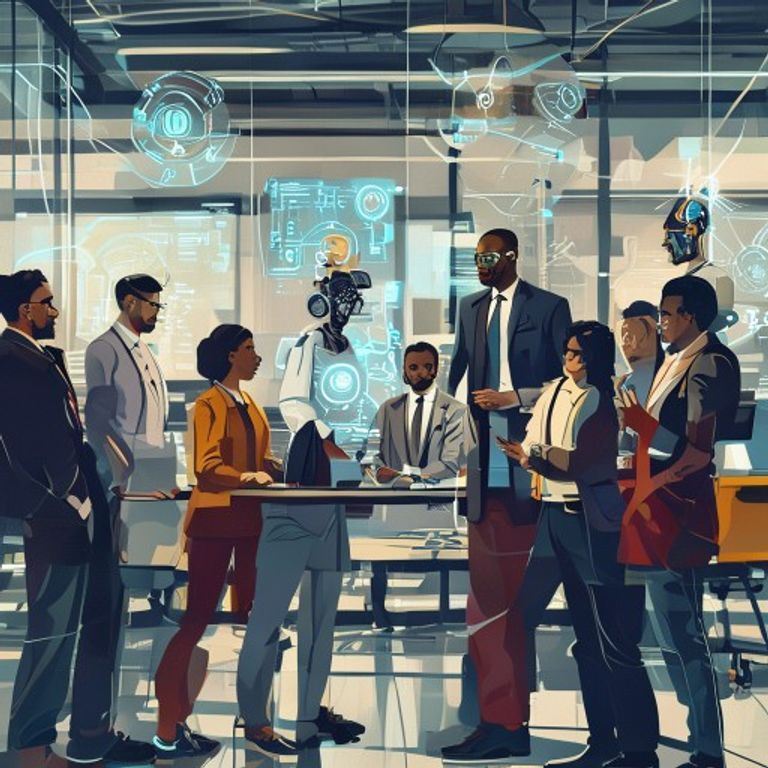
In an era defined by unprecedented technological advancement, Artificial Intelligence (AI) stands at the forefront of a global transformation, fundamentally reshaping industries, societies, and most profoundly, the very nature of work. The conversation around AI and Employment is no longer a futuristic speculation but a pressing contemporary reality, sparking both excitement over increased productivity and profound anxiety regarding widespread job displacement. As AI systems become increasingly sophisticated, capable of performing complex tasks with efficiency that often surpasses human capabilities, the world grapples with a pivotal question: is AI an inevitable disruptor poised to dismantle traditional labor markets, or is it a powerful enabler destined to create new economic opportunities and elevate human potential?
This article delves into the multifaceted impact of artificial intelligence on the global workforce, examining the mechanisms through which AI influences job creation and destruction, the critical role of reskilling and education, and the broader economic and ethical implications. We aim to provide a comprehensive, fact-based overview, navigating the complexities of this evolving landscape to offer insights into how individuals, businesses, and governments can proactively adapt and thrive in an AI-driven future.
The Genesis of Automation: A Historical Perspective
To understand the current AI-driven shift, it’s essential to contextualize it within a broader history of technological revolutions. From the agricultural revolution that reshaped human settlements and labor, to the industrial revolutions that saw steam power, electricity, and then computing mechanize vast sectors of industry, each epoch brought about fears of job losses alongside unparalleled advancements in productivity and living standards. The Luddites of the 19th century, protesting against textile machinery, serve as a historical echo of today’s anxieties regarding AI. However, history also demonstrates a consistent pattern: while certain jobs become obsolete, new, often more specialized and higher-value roles emerge, typically requiring different skill sets.
The digital revolution of the late 20th century, particularly the advent of personal computing and the internet, automated routine information processing tasks, leading to the decline of roles like typists and filing clerks, but simultaneously giving rise to an entire information technology industry. AI represents the latest, and arguably most profound, wave in this ongoing evolution, differing from previous automation by its capacity for learning, reasoning, and even creativity – capabilities once thought exclusive to human intellect.
AI’s Inroads: The Current Global Employment Landscape
Automation Across Industries: Where AI is Taking Hold
Artificial intelligence is no longer confined to research labs; it is deeply embedded in various sectors, transforming operational efficiencies and service delivery. Its applications are broad and diverse:
- Manufacturing and Logistics: Robotic process automation (RPA) and AI-powered robots are streamlining assembly lines, inventory management, and supply chain logistics, leading to faster production and reduced errors. This often means fewer manual laborers but a greater need for engineers and technicians to manage these sophisticated systems.
- Customer Service: Chatbots and virtual assistants powered by natural language processing (NLP) handle a significant volume of customer inquiries, providing instant support and freeing human agents for more complex issues.
- Healthcare: AI assists in diagnostics (e.g., analyzing medical images for anomalies), drug discovery, personalized treatment plans, and administrative tasks, enhancing patient care and operational efficiency.
- Finance and Banking: Algorithmic trading, fraud detection, credit scoring, and personalized financial advice are increasingly driven by AI, leading to more secure and efficient financial operations.
- Transportation: Autonomous vehicles, from self-driving cars to delivery drones, promise to revolutionize logistics and personal mobility, though regulatory and ethical challenges remain.
- Creative Industries: AI tools are aiding content creation, graphic design, music composition, and even journalism, augmenting human creativity rather than entirely replacing it, for now.
The pervasive nature of AI’s integration underscores that its impact is not monolithic but varies significantly based on the industry, specific tasks involved, and the level of human-AI collaboration.
The Dual Edges of AI: Displacement and Creation
Job Displacement: The Apprehension and Reality
The most immediate and often discussed concern surrounding AI is its potential to displace human workers. Jobs characterized by repetitive, predictable, and rule-based tasks are most vulnerable. This includes:
- Routine Administrative Roles: Data entry, clerical tasks, and routine office management are increasingly handled by RPA and AI algorithms.
- Manufacturing and Assembly: While advanced robotics have been present for decades, AI enhances their capabilities, allowing for greater autonomy and precision, potentially reducing the need for human operators on factory floors.
- Customer Service Representatives: As mentioned, chatbots are taking over a substantial portion of customer interactions, particularly those involving frequently asked questions or simple transactions.
- Truck Drivers and Delivery Personnel: The rise of autonomous vehicles poses a significant threat to long-haul trucking and last-mile delivery jobs.
- Certain Analytical Roles: Even some white-collar jobs involving data analysis or report generation can be partially automated by AI, requiring human oversight rather than manual execution.
It’s crucial to distinguish between tasks being automated and entire jobs being eliminated. Often, AI automates specific tasks within a job, allowing humans to focus on higher-level, more strategic, or interpersonal aspects. However, for some roles, particularly those heavily reliant on such tasks, the shift can indeed lead to significant job reduction.
Job Creation: New Frontiers and Opportunities
While some jobs face obsolescence, AI simultaneously acts as a powerful engine for new job creation. This isn’t just about replacing old jobs with new ones; it’s about fundamentally redefining industries and requiring entirely new skill sets. Emerging roles include:
- AI Engineers and Developers: Professionals who design, build, and maintain AI systems, algorithms, and machine learning models.
- Data Scientists and Analysts: Experts who collect, clean, interpret, and leverage vast datasets to train AI models and extract insights.
- AI Ethicists and Governance Specialists: Roles focused on ensuring AI systems are developed and deployed responsibly, addressing issues of bias, privacy, transparency, and accountability.
- Prompt Engineers: A nascent but growing field focused on crafting effective prompts for generative AI models to achieve desired outputs, bridging the gap between human intent and AI execution.
- Robotics Technicians and Operators: Specialists who install, maintain, and troubleshoot robotic systems in various industrial and service settings.
- Human-AI Interaction Designers: Professionals who design intuitive and effective interfaces for humans to interact with AI systems.
- Cybersecurity Analysts (AI-enhanced): With increased reliance on AI, securing these complex systems from cyber threats becomes paramount, often using AI itself to detect anomalies.
- Augmented Reality/Virtual Reality Developers: As AI powers more immersive experiences, these roles will grow, often integrating AI for intelligent environments and interactions.
These new roles often demand a blend of technical proficiency, critical thinking, problem-solving abilities, and an pragmatic understanding of human-computer interaction. They highlight a shift towards jobs that augment human intelligence and creativity, rather than simply replicating manual labor.
Addressing the Skills Gap: The Imperative for Reskilling and Education
Lifelong Learning in the Age of AI
The rapid pace of AI development necessitates a fundamental shift in how societies approach education and workforce development. The traditional model of front-loaded education followed by decades of static employment is no longer viable. Lifelong learning, continuous upskilling, and reskilling are becoming critical for individuals to remain relevant in the evolving job market.
- Digital Literacy: Basic understanding of AI, data, and digital tools is becoming a foundational skill across all professions.
- STEM Skills: A strong emphasis on science, technology, engineering, and mathematics remains crucial for driving AI innovation and managing its deployment.
- Soft Skills: Ironically, as AI automates routine cognitive tasks, uniquely human skills gain prominence. These include:
- Critical Thinking and Problem-solving: Applying human judgment to complex, ambiguous situations where AI provides data but not necessarily solutions.
- Creativity and Innovation: Developing novel ideas, products, and services that AI can then help execute.
- Emotional Intelligence: Understanding and managing emotions, crucial for leadership, teamwork, customer relations, and ethical decision-making.
- Collaboration and Communication: Working effectively with diverse teams and explaining complex AI concepts to non-technical stakeholders.
- Adaptability and Resilience: The ability to learn new skills and adapt to changing job roles and technological environments.
Government and Corporate Initiatives
Governments, educational institutions, and corporations globally are recognizing this imperative. Initiatives include:
- Public-Private Partnerships: Collaborations to develop targeted training programs and apprenticeships for AI-related fields.
- Subsidized Training Programs: Government-backed schemes to help workers transition into new roles through free or low-cost courses.
- Curriculum Reform: Educational systems at all levels are revising curricula to integrate AI literacy, coding, and problem-solving skills from an early age.
- Corporate Reskilling Programs: Companies are investing heavily in internal training to upskill their existing workforce, recognizing that it’s often more cost-effective than constant external recruitment.
Economic Implications: Productivity, Inequality, and Policy Responses
Boosting Productivity and Economic Growth
Proponents of AI argue that it can significantly boost global productivity, leading to economic growth and higher living standards. By automating routine tasks, AI allows businesses to operate more efficiently, innovate faster, and allocate human capital to more complex and creative endeavors. This can translate into increased GDP, new industries, and potentially lower costs for goods and services.
Exacerbating Inequality?
However, concerns persist that AI could exacerbate economic inequality. If the benefits of AI primarily accrue to a small segment of highly skilled workers and capital owners, while displacing a large portion of the lower and middle-skilled workforce, it could lead to widening wealth gaps. This concern is particularly acute in societies with weak social safety nets or inadequate education systems.
Policy Responses: Navigating the Transition
Governments worldwide are exploring various policy responses to mitigate the negative impacts of AI and harness its benefits:
- Social Safety Nets: Strengthening unemployment benefits, retraining programs, and potentially exploring concepts like Universal Basic Income (UBI) to provide a safety net during periods of transition.
- Investment in Education and Training: Directing substantial public funds towards accessible and future-proof education and vocational training.
- Regulatory Frameworks: Developing regulations for AI that address issues like algorithmic bias, data privacy, and the ethical use of automation, ensuring fair competition and worker protection.
- Taxation of Automation: Some economists propose taxing robots or automated systems to fund social programs or compensate for displaced labor, though this remains a highly debated topic.
- Promoting Human-AI Collaboration: Policies that encourage the design of AI systems that augment human capabilities rather than entirely replacing them.
Global Perspectives: Developed vs. Developing Nations
The impact of AI on employment is not uniform across the globe. Developed nations, with their strong technological infrastructure and highly skilled workforces, may be better positioned to adapt to AI, focusing on creating new high-value jobs. However, they also face the challenge of transitioning large numbers of workers from traditional industries.
Developing nations face a unique set of challenges and opportunities. On one hand, AI could allow them to “leapfrog” traditional industrialization stages, adopting advanced technologies directly. For example, AI-driven agriculture or telemedicine could revolutionize sectors previously hampered by lack of resources. On the other hand, countries heavily reliant on low-skilled manufacturing or service exports could see massive job losses if these tasks are easily automated, potentially hindering economic development and exacerbating existing inequalities.
India’s Stance: A Case Study
India, with its large young population and thriving IT sector, presents a complex case. While its tech hubs are at the forefront of AI development and adoption, creating high-skill jobs, a significant portion of its workforce is in sectors vulnerable to automation, such as manufacturing, retail, and agriculture. The government and private sector are investing in digital skill initiatives, but the scale of the challenge in reskilling millions remains immense. India’s strategy involves leveraging its talent pool to become a global AI hub while simultaneously addressing the need for inclusive growth and skill development across diverse socio-economic strata.
Ethical Considerations and Responsible AI Deployment
Beyond economic shifts, the widespread adoption of AI in employment raises significant ethical questions. Issues such as algorithmic bias in hiring processes, surveillance in the workplace, and the erosion of human decision-making autonomy require careful consideration. Ensuring AI systems are developed and deployed ethically, with transparency, fairness, and accountability at their core, is paramount to building trust and fostering a positive future of work.
Conclusion: Charting a Proactive Course
The impact of AI on global employment is undeniably profound and far-reaching. It is not merely a question of whether jobs will be lost or gained, but how the very nature of human work will transform. While the prospect of widespread automation can be daunting, a purely dystopian view overlooks the immense potential of AI to augment human capabilities, create new industries, and solve complex global challenges. The narrative of AI and Employment is one of adaptation, innovation, and strategic foresight.
Successfully navigating this transition requires a concerted, multi-stakeholder effort. Individuals must embrace lifelong learning and cultivate uniquely human skills. Businesses must invest in their workforce, fostering cultures of innovation and human-AI collaboration. Governments must implement forward-thinking policies that support education, provide robust social safety nets, and establish ethical guidelines for AI development. By approaching AI not as an adversary but as a powerful tool to be wielded responsibly, societies worldwide can chart a proactive course towards a future where technology serves humanity, creating a more productive, equitable, and fulfilling world of work.